
Uncle Pai, as he was fondly called, inculcated in Indian children a love for and interest in India's glorious past and its heroes.

'As we expect the economy to continue to grow above the trend line, we expect capex decisions to be taken next year when there is more certainty about the cost of funding and the economy.'

After navigating the turbulent pandemic waves, the recovering Indian economy is now sailing through unchartered waters of rising coronavirus cases, spiralling commodity prices and spiking inflation though the lighthouse of sustainable growth remains visible. As 2022 begins, a raft of developments, ranging from Budgetary announcements to continuation of stimulus measures to monetary policy, will set the tone for the domestic economy, which is projected to grow more than 9 per cent in the current fiscal ending March 2022. The country's continuing massive vaccination drive and 'precaution' doses starting for select categories of people this month will provide a firewall against any steep spike in coronavirus cases amid the emergence of the Omicron variant.

Will 2022 be a year of contrasting narratives -- one filled with caution and the other with continued optimism?

Among major Sensex movers, Ultratech Cement rose over 4 per cent, Bajaj Finance by 2.63 per cent and Maruti by 2 per cent. BSE Sensex closed up by 133.14 points at a record high of 47,746.22. NSE Nifty rose by 49.35 points at its lifetime high of 13,981.95.

The economy is gaining traction with gradual pick up in manufacturing activity and moderation in contraction of services, spurred by comfortable liquidity conditions, an RBI article on Tuesday said. Observing that the retreat of the second wave of coronavirus pandemic has been slow, the RBI in an article on the 'State of Economy' said, the aggregate demand conditions are buoyed by the release of pent-up demand post unlock, while the supply situation is improving with the monsoon catching up to its normal levels and sowing activity gaining pace. "Reaffirming the traction that the economy is gaining, the manufacturing activity is gradually turning around, while contraction in services has moderated.
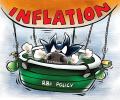
The Reserve Bank of India on Friday raised the retail inflation forecast for 2021-22 to 5.7 per cent due to supply side constraints, high crude oil and raw materials cost. The RBI in June had pegged the retail inflation estimate at 5.1 per cent for the current financial year. The RBI has the mandate to keep inflation in a band of 2-4 per cent, with a tolerance level of 2 per cent on either side.

The laggards include FMCG (16 per cent), Energy (37 per cent) and Media (34 per cent).

22 cases of the Delta Plus variant of the coronavirus have been detected in India, with 16 of them being reported from Maharashtra and the remaining from Madhya Pradesh and Kerala, the government said.

But their trajectory and direction have been largely influenced by politics and the political leadership's understanding of how the economy needs to be managed, explains A K Bhattacharya.

It goes without saying that the best performers are in the private sector, says TN Ninan.
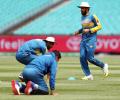
Due to the novel coronavirus outbreak, cricket in Pakistan, like the rest of the world, has been halted since March 15, and the PCB is banking on the virtual initiative to give a peek into its players' fitness.

All Sensex components ended on a positive note with IndusInd Bank surging over 22 per cent, followed by Axis Bank, Mahindra and Mahindra, ICICI Bank, HUL, Maruti, HCL Tech and Hero MotoCorp.

'If the third wave of Covid infections is as bad as the second one, the market may get very polarised with a preference for blue-chips with low volatility.'
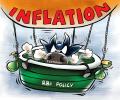
RBI Governor Shaktikanta Das on Friday said that inflation is on a declining trajectory, as it has fallen by 170 basis points from its January 2020 peak. Retail inflation fell to four-month low of 5.91 per cent in March over the previous month, mainly due to easing food prices.

These kinds of assumptions to be used for a nation of India's size and "to put us in poor light is not desirable"

The market breadth has turned sharply positive since May amid hopes that a decline in Covid-19 infections will lead to a revival in the economy. At 3.8, the advance-decline ratio (ADR) for May was the best since June 2020. So far this month, the ratio has remained above three - in simpler words, for every declining stock, there were nearly four advancing stocks in May and three this month. ADR is a popular market breadth indicator, with a ratio of more than two signalling an extremely bullish undercurrent.

A 9-minute lights-out by most of households on Sunday evening can potentially collapse the grid due to sudden drop and then a quick surge after the event. But to manage the dramatic changes in electricity and its impact on the grid, the government has drawn an elaborate plan to manage it.

This is reflected in an improvement in their sentiments as well, explains Mahesh Vyas.
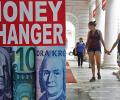
The Indian rupee tumbled in line with its Asian peers due to persistent risk-off sentiment on the back of broad dollar strength.

A selection of musings from around the cricket World Cup.

Reliance Industries was the top gainer in the Sensex pack, surging over 3 per cent, followed by Bajaj Finserv, IndusInd Bank, HDFC twins and Kotak Bank. NSE Nifty surged 143.25 points or 1.18 per cent to 12,263.55.

The government has to focus on real solutions, not make a mockery of the crisis through 'vaccine festivals',' asserts T N Ninan.

The country's top FMCG stocks, such as Hindustan Unilever, ITC, Nestl, Britannia, Godrej Consumer Products, and Dabur, among others, are currently trading at around 41x their trailing 12-month earnings, down from their peak P/E multiple of around 48x at the end of December 2018.

Nikunj Saraf, Vice President Choice Wealth, answers your mutual fund queries.

The relentless rally in small- and mid-cap stocks continues as large-caps show signs of fatigue. In July, the Nifty Smallcap 100 rose 8.1 per cent, extending its year-to-date (YTD) gains to 48.5 per cent, while the Nifty Midcap 100 added 3.1 per cent, taking its YTD rise to 33.5 per cent. On the other hand, the Nifty50 remained unchanged for the month, with YTD gains of 12.7 per cent.

'We know that there are new variants which are more transmissible. We know that human behaviour determines the spread of this virus. Therefore, it is not very relevant if we declare whether the second wave is over or not'

The hit to economic activity will be mostly confined to the first quarter. And a third wave, if it materialises, is unlikely to be hugely disruptive for the economy, predicts T T Ram Mohan.

Oil and Natural Gas Corp, which had last year firmed up an investment of Rs 34,012 crore (USD 5.076.37 billion) in bringing to production 10 oil and gas discoveries in its Bay of Bengal block KG-DWN-98/2 (KG-D5), plans to invest another Rs 21,528.10 crore (USD 3.2 billion) in developing the ultra-deepsea UD-1 find.

The sources said the focus of the talks was to take forward the disengagement process in friction points like Hot Springs, Gogra and Depsang in eastern Ladakh.

India and China on Saturday held another round of military talks with a focus on taking forward the disengagement process in Hot Springs, Gogra and Depsang in eastern Ladakh and bring down the tensions in the region, official sources said.

P-note is, however, now not a preferred route for investing in India as Sebi has made registration easier and also desirable for FPIs.

It is nearly after 13 years that a foreign brokerage has resumed holistic coverage on stocks of public sector banks (PSBs). To that extent, Morgan Stanley's report dated March 3, where the analysts have listed their order of preference for PSB stocks, is an indication that the state-owned banks may once again be attracting some interest, thanks to three back-to-back quarters of good results in FY21 so far. "State-owned banks' balance sheets have improved, and bad loans formation should moderate going forward," the analysts note and this is the key reason for them to relook at their stance on PSBs. While State Bank of India (SBI) remains their preferred pick, stocks of Bank of Baroda (BOB) and Punjab National Bank (PNB) have been upgraded from 'underweight' to 'equal-weight'. The brokerage maintains its underweight recommendation on Bank of India and Canara Bank.

India's macroeconomic situation is improving fast and the country's GDP growth will turn positive in the third and fourth quarters of the current financial year, eminent economist Ashima Goyal said on Sunday. Goyal in an interview to PTI said the management of the COVID-19 pandemic and gradual unlocks announced by the government have helped in avoiding multiple COVID-19 peaks. The growth estimates by different agencies are being continuously revised, she said.

Cricket is set to touch a new high. Europe's longest glacier in the Swiss Alps will soon host an exhibition match between two all-star teams from India and England, at an altitude of 11,330 feet, surrounded by snow-clad peaks.

While Rakesh Jhunjhunwala is up 14.9% during the year to Rs 12,381 cr, Ashish Dhawan is up 68.4% to Rs 810 cr, Ashish Kacholia is down 23.4% to Rs 515 cr, Rajiv and Dolly Khanna are down 74.6% to Rs 116 cr and Vijay Kedia is down 6.2% to Rs 294 cr.

'While most companies were bullish before the second wave of double-digit sales growth in FY22, that may not be the case now.'

FY22 will be the year to rebuild with the IMF projecting output growth at 11.5 per cent, economic survey at 11.0 per cent and the RBI's Monetary Policy Committee at 10.5 per cent.

Portfolio returns, say analysts at Morgan Stanley, are more likely to be driven by bottom-up stock-picking rather than top-down macro forces.
Top Sensex gainers include Hero MotoCorp, Bajaj Auto, Asian Paints, IndusInd Bank, HUL, and Maruti, rallying up to 5.87 per cent. While, ICICI Bank, NTPC and ITC slipped up to 0.13 per cent.
